The Tyranny of the Flashing Toy
Walk into a modern playroom, and you are likely to be bombarded by a symphony of electronic beeps, flashing LED lights, and pre-recorded voices telling your child exactly what to do. Today's commercial toy market is saturated with 'smart' gadgets designed to entertain, distract, and guide. While these high-tech toys promise accelerated learning, they often do the exact opposite. By providing pre-programmed pathways and instant gratification, they relegate the child to a passive consumer of entertainment rather than an active creator of worlds.
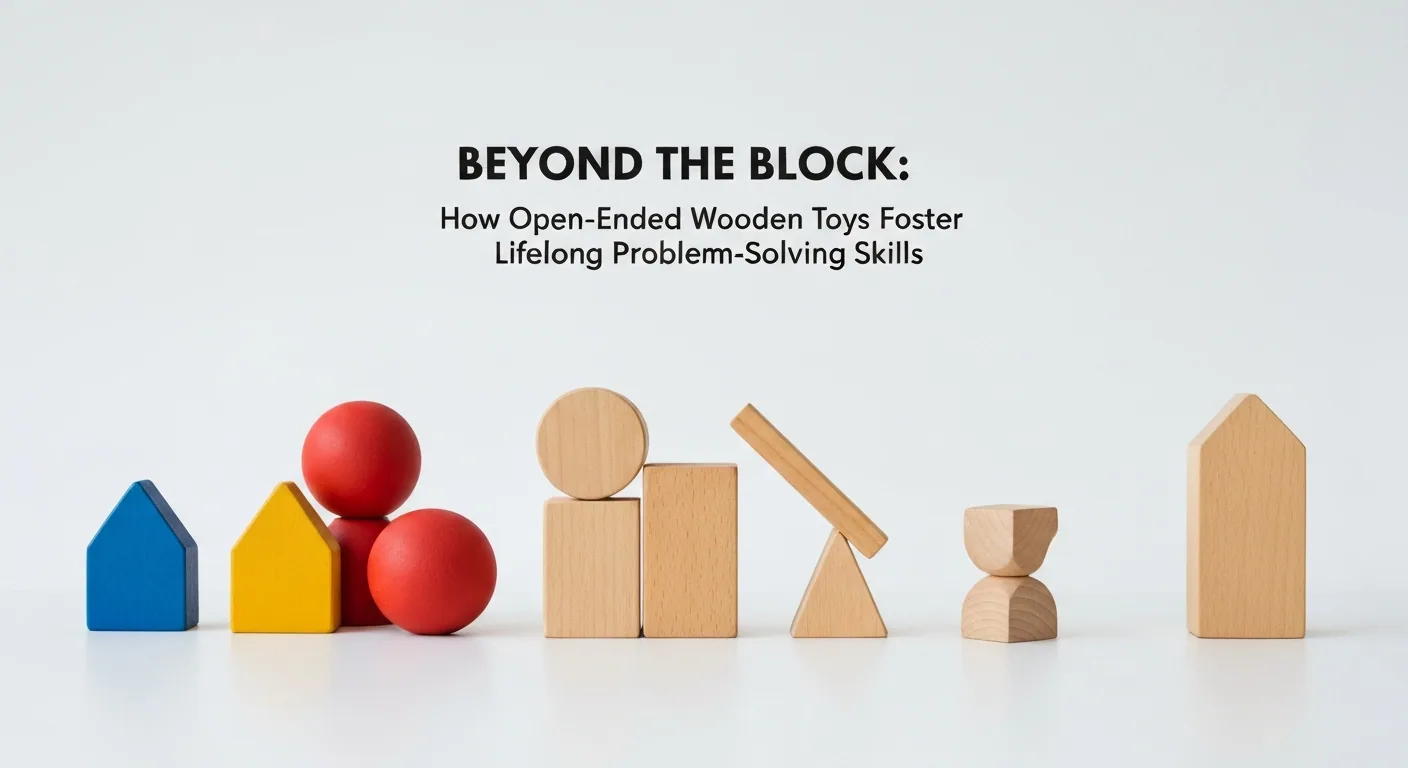
In stark contrast stands the humble wooden block. It does not sing, it does not light up, and it does not have an on-off switch. Yet, this very lack of features is its greatest strength. When a toy does less, the child must do more. Simple, natural, open-ended wooden toys act as a blank canvas, shifting the cognitive heavy lifting from the microchip to the mind. By stripping away artificial distractions, wooden toys encourage children to engage in deep, self-directed play that lays the foundation for advanced, lifelong problem-solving abilities.
What is Open-Ended Play?
To understand why wooden toys are so powerful, we must first look at the concept of open-ended play. An open-ended toy is any plaything that can be used in multiple ways, depending entirely on the child's imagination and developmental stage. A set of wooden arches can be stacked into a tower, lined up to create a winding road, turned upside down to serve as rocking cradles for dolls, or arranged as a structural bridge for toy cars.
Closed-ended toys, by contrast, have a single, predetermined outcome. A plastic steering wheel that plays a car sound when pressed has only one function. Once the child masterfully presses the button, the mystery is gone, and the learning cycle concludes. Open-ended play encourages lateral thinking—the ability to find multiple solutions to a single challenge. This cognitive flexibility is a cornerstone of creative genius and high-level analytical reasoning, preparing children to navigate an unpredictable, non-linear world.
Building Blocks of Spatial Intelligence
Long before a child encounters geometry or physics in a classroom, they learn the rules of the physical universe through tactile exploration. Simple wooden blocks, planks, and geometric shapes are superb instruments for teaching spatial intelligence. When a child interacts with wooden materials, they receive authentic physical feedback. Unlike lightweight plastic, wood has weight, friction, texture, and density.
As a child attempts to balance a heavy rectangular block on top of two thin vertical cylinders, they are actively calculating concepts of gravity, center of mass, and structural stability. If the tower collapses, it is not a digital failure screen; it is a real-world scientific result. The child must analyze why the structure failed and adjust their strategy. This direct loop of trial, error, and physical feedback builds intuitive mechanical reasoning that textbooks can never fully replicate.
Developing Executive Function and Resilience
Executive function refers to a suite of mental processes that includes working memory, cognitive flexibility, self-regulation, and planning. These skills are far more predictive of academic and life success than early reading or rote memorization. Open-ended wooden toys are exceptional tools for building executive function because they require children to formulate an internal plan and execute it from scratch.
Consider a child deciding to build a medieval castle out of basic wooden blocks. First, they must hold the mental image of the castle in their working memory. Next, they must categorize and select the appropriate blocks. When a key archway collapses halfway through the project, the child must manage their frustration, practice emotional self-regulation, and redesign the structure. This iterative process of overcoming physical obstacles builds emotional resilience and teaches children that failure is merely a data point in the journey toward a solution.
Combating Overstimulation and Nurturing Focus
Electronic toys are engineered to trigger dopamine releases through sensory novelty. While this keeps a child's attention glued to the device, it often leads to hyper-stimulation, shorter attention spans, and irritability once the screen or sound stops. The quiet, sensory-neutral nature of wood offers a much-needed sanctuary for the developing brain.
Wooden toys encourage 'slow play,' characterized by deep focus, sustained attention, and calm contemplation. Without an electronic script dictating the pace, children fall into a state of 'flow'—the highly productive mental state where learning and creative synthesis peak. A child who learns to concentrate on building a complex wooden marble run for an hour is training their brain for the sustained focus required in adult academic, artistic, and scientific pursuits.
Collaborative Building and Social Problem-Solving
Problem-solving is rarely a purely solitary endeavor; in the real world, it almost always requires collaboration, communication, and compromise. Because wooden toys do not have fixed roles, they naturally invite cooperative play. When two or more children sit down with a pile of wooden blocks, they are forced to negotiate.
- They must communicate their individual visions and merge them into a shared goal.
- They must negotiate the distribution of scarce resources (e.g., who gets the coveted triangular roof pieces).
- They must coordinate their physical movements to build complex structures together without knocking them down.
- They must verbally troubleshoot when parts of their shared project fail.
This social negotiation builds empathy, verbal expression, and collective problem-solving skills that are impossible to practice while staring at an interactive screen.
The Long-Term ROI: From Sandbox to Boardroom
It is tempting to view childhood play as merely a way to pass the time until formal education begins. However, the play habits of early childhood directly shape the neural pathways used in adulthood. The ability to look at a collection of disparate objects and see a cohesive system is exactly what top-tier engineers, software developers, and architects do every day.
When we give children toys that solve all their problems for them, we raise passive consumers. When we give them simple, high-quality wooden toys, we invite them to become inventors, designers, and innovators. The child who spent hours figuring out how to balance an asymmetrical wooden sculpture is the adult who will look at a complex corporate bottleneck or a broken piece of technology and confidently find a novel, elegant solution.
Curating a Mindful Play Space
Transitioning to a playroom focused on open-ended wooden toys does not require a massive investment, nor does it mean throwing out every plastic toy your child owns. Instead, it is about shift in mindset. Aim to curate a minimalist environment where quality is prioritized over quantity.
Start by introducing a classic set of unit blocks, some wooden rainbow arches, and a collection of simple wooden figures or vehicles. Keep these toys stored in low, accessible shelves where their natural beauty is visible, inviting the child to reach out and create. By stepping back, resisting the urge to intervene, and allowing your child to struggle and succeed with these simple tools, you are giving them the greatest gift of all: the confidence in their own mind's ability to solve the mysteries of their world.